The Childhood We Had vs. The Childhood Our Kids Have
A nostalgic look at how childhood has changed from outdoor games, face-to-face friendships, and simple joys in the 90s to today's screen-driven world. While modern childhood offers incredible opportunities, the real question is how we can preserve the freedom, creativity, and meaningful experiences that make childhood unforgettable.

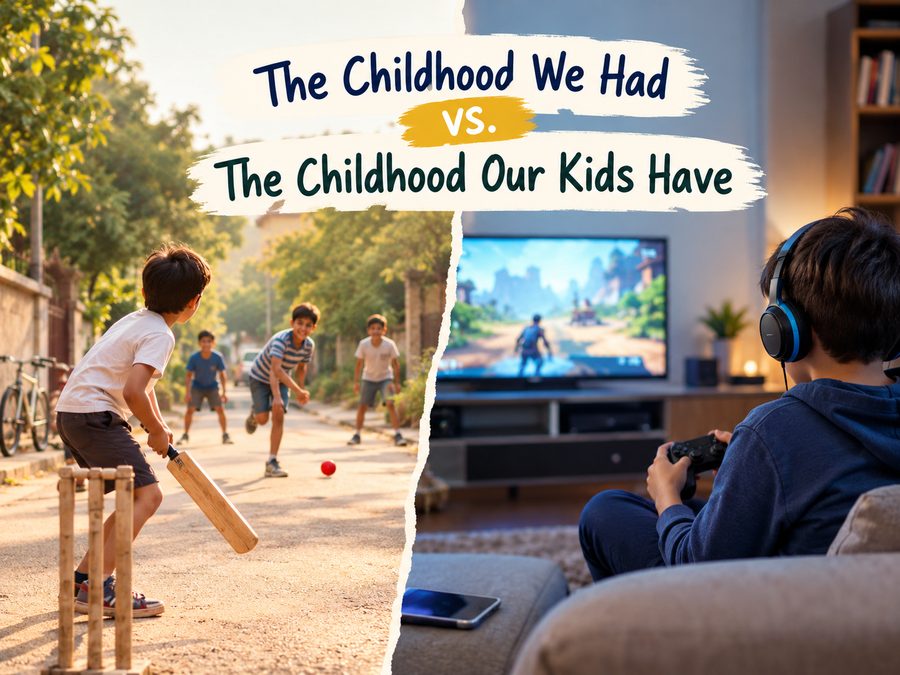
Do you remember when your mother had to call you three or four times before you finally came home to eat? When a bicycle, a cricket bat, and a few friends were enough to make your entire day?
Now look at the children around us. Many can spend hours watching videos, playing games on a tablet, or scrolling through a phone without even realizing how quickly time passes.
It makes you wonder: Have childhoods really changed, or have we changed the world in which children grow up?
If you grew up in the 1990s, you probably have a collection of memories that today's children may find difficult to imagine. And if you're raising children today, you might sometimes wish they could experience even a little of the childhood you had.
Let's take a walk down memory lane.
1. When the Streets Were Our Playground
For children growing up in the 90s, the neighbourhood was often the centre of the universe.
We played cricket in narrow streets, rode bicycles until our legs hurt, climbed trees, played hide-and-seek, and invented games using whatever we could find.
A few bricks could become the wickets for a cricket match. A broken plastic ball was still good enough for another game. Nobody cared whether the equipment was expensive or whether the playground looked perfect.
All we needed were friends.
And finding them was easy. You simply knocked on a friend's door or shouted their name from outside.
"Is Ahmed coming out to play?"
Sometimes his mother would say he was studying. Sometimes she would tell us to come back later. And sometimes five or six children would gather within minutes, ready to turn an ordinary afternoon into an unforgettable adventure.
Today, many children spend their free time indoors. Some enjoy online games with friends, while others watch videos or explore social media.
There is nothing inherently wrong with these activities. Technology can entertain children and even help them learn. But it cannot completely replace the feeling of running outside, falling down, getting back up, and laughing with friends until sunset.
We didn't need someone to entertain us. We knew how to entertain ourselves.
2. Boredom Was the Beginning of Something Fun
Remember telling your parents, "I'm bored," and hearing them reply, "Go and find something to do"?
They weren't going to hand you a phone to keep you occupied. You had to figure it out yourself.
Perhaps you started drawing on old newspapers, made a paper aeroplane, built something out of cardboard, or annoyed your younger sibling until the two of you invented a game.
Sometimes, you did absolutely nothing. You lay on the floor, stared at the ceiling, and let your imagination wander.
And somehow, an idea would eventually appear.
Today, boredom often lasts only a few seconds before a screen comes to the rescue.
A child waiting at a restaurant may immediately ask for a phone. A long car journey can become a series of videos. Even a few quiet minutes at home can feel uncomfortable when there is nothing to watch.
Of course, parents are busy, and sometimes a phone is a convenient way to keep a child occupied. We shouldn't judge every parent who uses one.
But perhaps there is something worth remembering here.
Boredom isn't always a problem that needs to be solved immediately. Sometimes, it gives children the space to think, imagine, create, and discover what they enjoy.
Maybe the next great idea begins with a child who has nothing to do.
3. Friendships Were Built Face-to-Face
In the 90s, friendship meant spending time together.
You knew which friend could make you laugh when you were upset, which one always cheated at cricket, and which one would share their last packet of crisps with you.
You fought over the smallest things. One day, you might refuse to speak to your best friend because they wouldn't let you bat first. The next day, you would be playing together as if nothing had happened.
There were no long discussions about who had seen whose message or why someone hadn't replied.
You simply showed up.
And when a friend moved away, you genuinely missed them. You might write a letter, make an occasional phone call, or wait impatiently for the next school holiday.
Today, children can maintain friendships across cities and countries. They can play online together, send pictures instantly, and stay connected in ways we never could.
That's a wonderful thing.
Yet there is a difference between being connected and spending meaningful time together.
A child might have hundreds of online contacts but still feel lonely. Another might have only two close friends and feel completely understood.
The number of friends has never been the most important thing. What matters is having someone who listens, notices when something is wrong, and sits beside you when you need company.
Perhaps that's something every generation needs to learn.
4. Family Time Meant Something Different
Think about visiting your grandparents during the summer holidays.
There was often a familiar routine: the smell of food coming from the kitchen, cousins running around the house, adults talking about family matters, and someone insisting that you eat just one more helping.
Nobody needed to plan an elaborate activity. Simply being together was enough.
Even ordinary evenings had their own charm. Families might sit together watching television, discussing the day's events, or listening to stories about relatives and neighbours.
Children learned things without realizing they were learning. They picked up family traditions, listened to older people's experiences, and discovered how different generations viewed the world.
Today, family members can be sitting in the same room while each person looks at a separate screen.
A parent answers work messages. A teenager watches videos. A younger child plays a game. Everyone is physically present, but nobody is really sharing the moment.
This doesn't happen in every family, of course. Many families today make a real effort to spend quality time together.
But it raises an important question: when did being together become different from actually being present?
Imagine an ordinary evening when everyone puts their phones aside for half an hour. The family starts talking, someone tells a funny story, and suddenly everybody is laughing.
Nothing extraordinary happened.
Yet that might be the part of the day a child remembers years later.
5. We Had Less, but We Often Made More of It
A new toy in the 90s could keep a child excited for weeks.
We played with toy cars, dolls, marbles, building blocks, and whatever else we could get our hands on. Sometimes, the packaging was almost as interesting as the toy itself.
We didn't have endless entertainment available at the touch of a button. If we wanted to enjoy something, we often had to wait.
We waited for our favourite television programme. We waited for the weekend. We waited for birthdays, school holidays, and visits from cousins.
And that waiting made the moment feel special.
Today, children have access to more entertainment, more information, and more choices than ever before. They can watch their favourite cartoons whenever they want and learn new skills from people around the world.
These are genuine advantages.
But when everything is available immediately, it can become harder to appreciate any one thing for long.
A child receives a new toy and soon asks for another. A new game is exciting until the next one appears. A favourite video ends, and another starts before the child has even thought about what they watched.
The problem isn't that today's children have too much. It's that constant access can sometimes make it difficult to enjoy what they already have.
Perhaps we can teach them something simple: happiness doesn't always come from getting something new. Sometimes, it comes from discovering a new way to enjoy what you already own.
6. We Learned Lessons Without Calling Them Life Skills
Nobody organised a workshop to teach us teamwork when we played cricket in the street.
We learned it because we had to decide who would bat, who would bowl, and what to do when the ball landed in someone's garden.
Nobody gave us a formal lesson in negotiation when a disagreement broke out over whether a player was out.
We argued, defended our positions, listened to one another, and eventually found a way to continue playing.
Sometimes, we were unfair. Sometimes, we lost our temper. Sometimes, we had to apologise.
But those ordinary experiences taught us patience, compromise, resilience, and how to deal with people who didn't always agree with us.
Children today can develop these skills through sports, school activities, friendships, creative hobbies, and online communities. The opportunities are there.
However, when every difficulty is removed from a child's path, there may be fewer chances to learn how to handle disappointment independently.
If children never have to wait, how will they learn patience?
If adults resolve every disagreement for them, how will they learn to resolve conflicts?
And if they are never allowed to make small mistakes, how will they develop the confidence to recover from bigger ones?
Children don't need difficult lives to become resilient. They need opportunities to try, fail, learn, and try again, with supportive adults nearby.
7. Are We Romanticising Our Own Childhood?
Before we conclude that everything was better in the 90s, let's be fair.
Our childhoods weren't perfect.
Some children didn't have safe places to play. Some experienced loneliness, bullying, family difficulties, or pressure to succeed. We also lacked many of the educational resources, medical advances, and opportunities that children have today.
And not every child growing up in the 90s had a wonderful childhood.
Nostalgia has a way of making the past look brighter than it really was.
We tend to remember the cricket matches, the summer evenings, the laughter, and the friendships. We forget the ordinary disappointments and the difficult days.
Today's children are growing up in a different world, one that offers remarkable opportunities alongside new challenges.
They can learn almost anything online, connect with people from different cultures, and explore interests that might never have been available to us at their age.
The answer isn't to take technology away and pretend it's still 1995.
The answer is to keep the best parts of childhood alive, even as the world changes.
Let children enjoy technology, but also let them play outside.
Let them use online games to connect with friends, but encourage them to invite those friends over, too.
Let them enjoy their screens, but teach them to enjoy a quiet afternoon without one.
Most importantly, let them experience the world beyond the screen.
They don't need to have the childhood we had. They need a childhood that gives them room to laugh, explore, make mistakes, build friendships, and create memories of their own.
Before We Go, Think About This
Imagine your child as a grown adult, sitting with their own children twenty years from now.
What memories will they share?
Will they remember the games they played, the friends who made them laugh, the afternoons spent exploring, and the family evenings when everyone sat together?
Or will they struggle to remember what filled all those hours?
We cannot turn back time, and we don't need to.
But we can make small choices today that give our children more opportunities to experience life beyond a screen.
Take them cycling. Play a board game together. Let them help in the kitchen. Visit their grandparents. Encourage them to invite a friend over.
And every once in a while, let them experience the beautiful art of doing nothing.
You might be surprised by what happens next.
Perhaps they will invent a game, start a conversation, or ask you to tell them a story about your childhood.
And there you will be, sharing a memory that began long before they were born.
Because childhood isn't measured by how much entertainment a child has. It's measured by the experiences, relationships, and memories that stay with them long after the toys have been put away.
The world has changed. Childhood has changed with it.
But the things children need most haven't changed nearly as much as we think.
They still need love, friendship, freedom to explore, and someone who makes them feel that they belong.
And perhaps, more than anything else, they need time to simply be children.
Your Turn
If you grew up in the 90s, what is the one childhood activity you wish today's children could experience?
Playing cricket in the street? Riding bicycles with friends? Spending summer holidays at your grandparents' house? Or something completely different?
Share your memory in the comments. Let's bring a little of that childhood back to life.