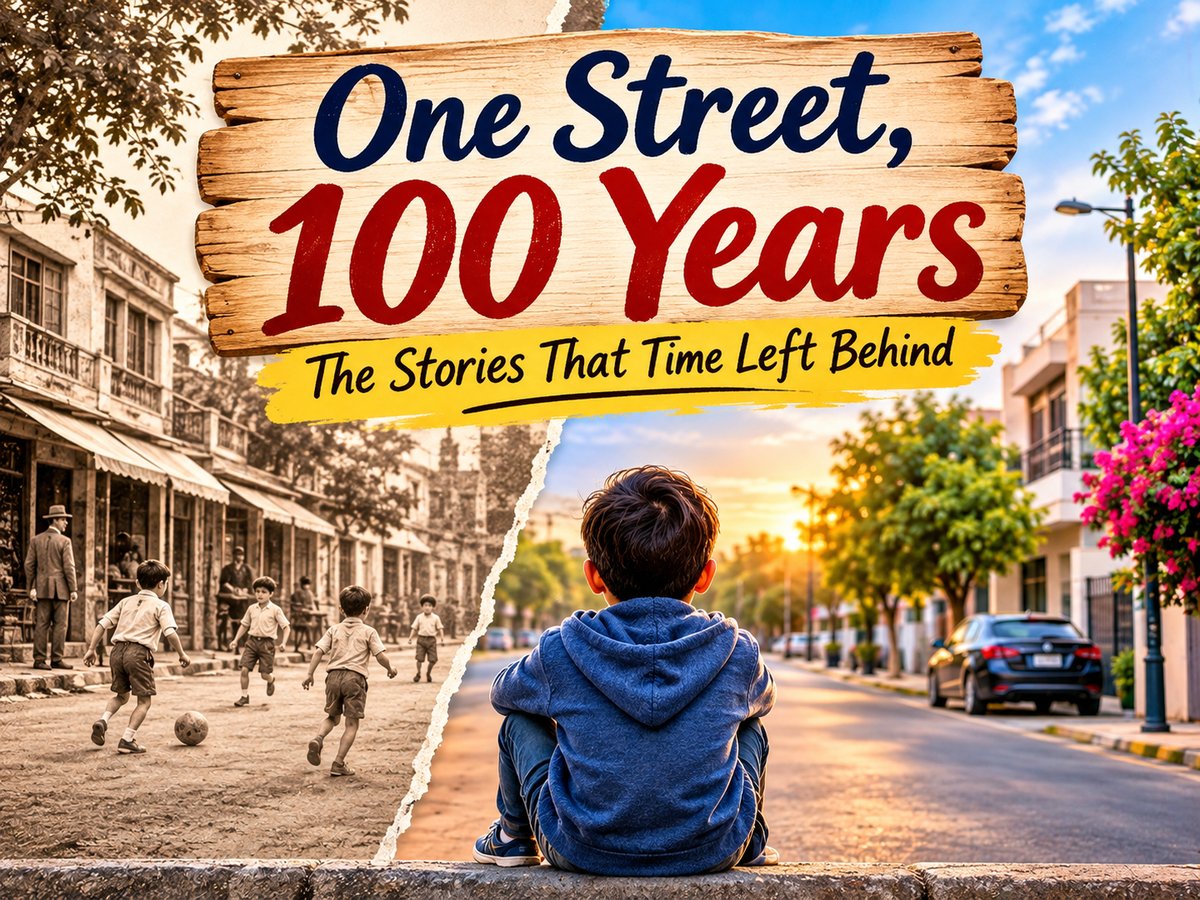
One Street, 100 Years: The Stories That Time Left Behind
A street is more than buildings and roads; it holds generations of memories, childhood friendships, family stories and moments that time can never truly erase. As the world changes, the people and places we once knew become part of our history, reminding us to cherish the ordinary moments we are creating today.

Buildings change, people move on, and familiar faces slowly disappear. But every street has a story, and sometimes the smallest memories are the ones that stay forever.
Imagine walking down the same street your grandparents walked a hundred years ago.
The road may be wider now. The old houses may have become modern apartments, and the little grocery shop on the corner might have been replaced by a supermarket. The trees may have disappeared, and the people who once filled the street with laughter may no longer be around.
But think about what that street has witnessed.
A hundred years of birthdays, weddings, childhood friendships, family gatherings, goodbyes and new beginnings. Thousands of ordinary lives, each with a story worth remembering.
A street is never just a road. It is a collection of memories.
When Neighbours Were Like Family
There was a time when people knew almost everyone living on their street.
You didn't need to call before visiting a neighbour. Children moved freely between houses, and mothers never worried too much about whose home their children were playing in.
There was always an elderly uncle sitting outside his house, watching children play cricket. There was an aunt who would send food to a neighbour without being asked. And there was always someone ready to help when a family was going through a difficult time.
Imagine a child falling off his bicycle. Before he could even get up, two neighbours would rush over. Someone would bring water, another would clean the wound, and someone else would inform his parents.
Nobody considered it a special act of kindness. It was simply what neighbours did.
Today, we may live in larger houses and better buildings, but many of us barely know the people living next door. We share elevators, parking spaces and corridors, yet rarely share a conversation.
We have become better connected digitally but, in many ways, less connected emotionally.
The Little Shop That Knew Everyone
Every old neighbourhood had that one small grocery shop where the owner knew almost every family.
He knew which child liked chocolate, which family bought bread every morning and who would occasionally come asking to pay for groceries later.
A little boy might visit after school with a few coins in his pocket. The shopkeeper would give him his favourite biscuits and sometimes an extra sweet.
Years later, that boy grows up, moves abroad and starts his own family.
One day, he returns to visit his childhood neighbourhood. The shop is still there, but the old shopkeeper is gone. Perhaps his children have taken over, or perhaps the shop has closed permanently.
He stands outside for a moment, looking at the familiar entrance.
Suddenly, he remembers his childhood, the little coins in his hand and the old man who always had a smile for him.
For someone else, it is just an ordinary shop.
For him, it is a piece of childhood that he can never get back.
The House That Heard Every Goodbye
Think about an old family house built by someone's grandparents.
It witnessed the beginning of a marriage, the arrival of children, their first steps, their school days and countless family dinners.
The courtyard was once full of children playing. The kitchen was always busy, and the dining table was rarely empty.
Then life happened.
The children grew up and moved to different cities. Some settled abroad. Grandparents grew older, and eventually, the family gatherings became less frequent.
One day, the youngest son returns to the house after many years. He walks through the rooms, touches the old wooden staircase and looks at the corner where his grandfather used to sit every evening.
His grandfather is no longer there.
The house has become quieter. The walls have been repainted, but the memories remain.
Perhaps the family will eventually sell the house. A new family will move in, change the furniture and make it their own.
But for the son, that house will always be the place where his childhood lives.
Some places are difficult to leave because they hold people we can no longer meet.
What the Street Has Seen
Imagine how much a street can change in a hundred years.
The narrow road becomes a busy commercial avenue. Small houses turn into apartment buildings. The old playground becomes a shopping centre, and the cinema where families once spent their weekends disappears.
Even the sounds change.
Children playing cricket are replaced by cars rushing through the streets. Street vendors disappear, and online deliveries become part of everyday life.
Yet, some things remain the same.
Parents still worry about their children. Young people still dream of a better future. Families still celebrate weddings, mourn their losses and hope for happier days.
People living in 1926 had their own struggles, just as we do in 2026.
They worried about money, education, relationships and the future. They experienced heartbreak, celebrated success and made sacrifices for their families.
Their world was different, but their emotions were not.
Perhaps that is why old photographs feel so personal. We look at strangers from another generation and realise that they were once living their present, just as we are living ours.
A Photograph From 2026
Now imagine it is the year 2126.
Someone discovers an old photograph of the same street, taken in 2026.
They see children playing outside, an elderly couple sitting near their front gate, a small shop and a few people standing together.
They begin asking questions.
Who were these people? What happened to them? Did they know each other? What were their dreams?
Perhaps someone recognises the photograph.
"That was your great-grandfather's house."
"That little shop belonged to our family."
"That tree was planted when your grandmother was young."
Suddenly, an old photograph becomes a family treasure.
But what if nobody recognises anyone? What if the stories disappear because nobody thought they were important enough to share?
We often assume that memories will somehow remain. But they don't always.
Our grandparents carry stories about streets, people and experiences that we may never hear unless we ask.
A simple conversation today could become a valuable family memory tomorrow.
We Are Someone's Memories Too
There is something quite emotional about realising that we are also part of someone else's past.
The street where our children play today may be the street they remember decades later. The little café where we meet friends may become a place they wish they could visit again. The ordinary family dinners we sometimes rush through may become their favourite childhood memories.
Think about it.
One day, our children might walk past their childhood home and tell their own children, "I grew up here."
They might remember the neighbour who always greeted them, the shop where they bought sweets, or the tree beneath which they played with friends.
We may not realise it, but we are creating memories every single day.
Perhaps we should take more photographs, listen to our grandparents' stories and appreciate the people who make our neighbourhoods feel like home.
Not everything meaningful needs to be grand. Sometimes, it is simply a familiar face, a friendly greeting or a cup of tea shared with a neighbour.
A Street Is More Than a Place
A hundred years from now, the street we know may be almost unrecognisable.
The buildings will change. Businesses will come and go. Families will move away, and new generations will take their place.
But somewhere in old photographs, family stories and people's hearts, the original street will continue to exist.
Perhaps that is the beauty of life. We are only temporary residents of places that carry stories much older than us. We arrive, make memories, leave our mark and eventually become part of someone else's history.
So, the next time you walk down your street, take a moment to notice it.
Look at the old houses. Appreciate the familiar shopkeeper. Say hello to the neighbour you usually pass without a word.
Because one day, these ordinary moments may become the memories we wish we could revisit.
One street. 100 years. Different generations, different lives, but the same human emotions.
And perhaps the most beautiful question is not what the street will look like a hundred years from now, but what stories will it tell about us?
Let's hear your story: If the street where you grew up could speak, what do you think it would remember about you? Is there an old shop, a neighbour, a childhood friend or a special place you still miss? Share your memories in the comments. Your little story might bring back someone else's beautiful memories too.