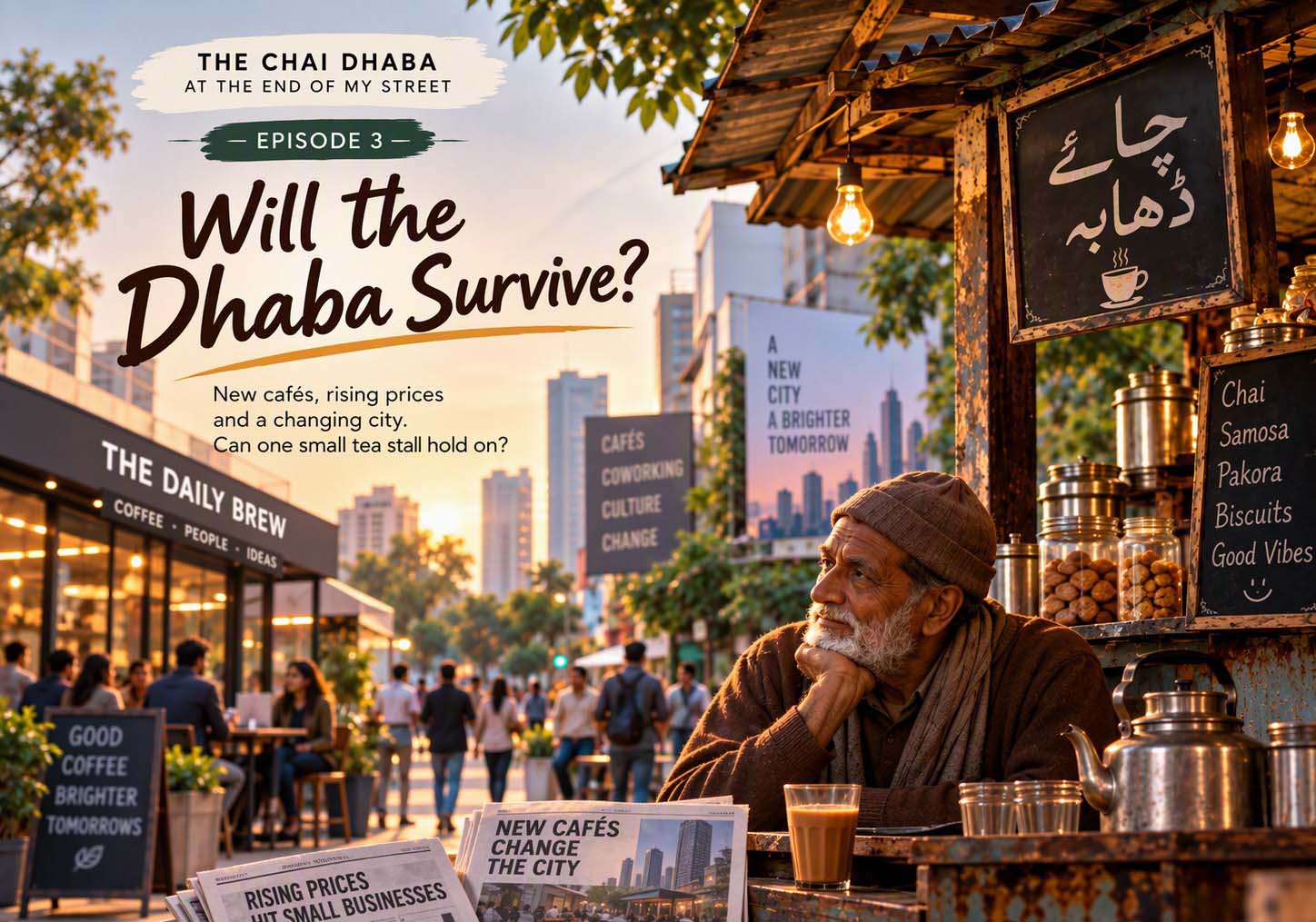
The Man Behind the Kettle
He has poured tea for thousands of people. Almost nobody has ever poured one for him.

It started with the rain.
It was a sticky evening in late July, the kind of Lahore evening when the air feels thick enough to drink. I was walking home from the market with two heavy shopping bags when the sky suddenly turned dark grey. Within seconds, the monsoon arrived. It wasn’t a gentle shower. It was a wall of water, crashing down so hard it bounced off the road.
I ran for the nearest shelter I could see: a small tin roof just outside our society gate.
I stood there, soaked to the skin, water dripping from my hair, my shopping bags slowly turning to paper mush. The rain on the tin roof was so loud it sounded like a thousand drums.
That’s when I noticed where I was.
A gas stove. A huge, blackened kettle. Two wooden benches full of strangers, all of them also caught by the rain: a rickshaw driver, two students, an old man with a newspaper held over his head, and a delivery rider wringing water out of his shirt.
And behind the kettle, a thin man with a grey beard and a white cap was calmly pouring tea, as if the end of the world were just another Tuesday.
Without asking, he handed me a small glass of steaming tea.
“I don’t have any change,” I said, fumbling with my wet wallet.
He waved his hand. “Drink first. Pay tomorrow. The rain isn’t going anywhere, and neither am I.”
So I sat down on the bench between the rickshaw driver and the old man, and I drank.
It was the best cup of tea I have ever had. Hot, sweet and creamy, with the gentle taste of cardamom. Around me, strangers who had never met were suddenly laughing and talking together, sharing complaints about the flooded roads and jokes about the city’s drains.
The rain lasted forty minutes. By the time it stopped, I knew the old man’s opinion on every cricketer in Pakistan, the rickshaw driver’s worries about his daughter’s school fees and the students’ plans to study abroad.
Here’s the strange part. I had walked past this dhaba almost every day for years. I’d seen its tin roof and its wooden benches thousands of times. But I had never once sat down.
It took a monsoon to bring me in.
The next day, I went back to pay for my tea. And the day after that. And the day after that.
Eventually, I asked the man behind the kettle if I could write his story.
A Kettle, a Stove and Two Benches
The dhaba sits just outside our society’s main gate, where the road bends towards the main boulevard. If you didn’t know it was there, you might miss it.
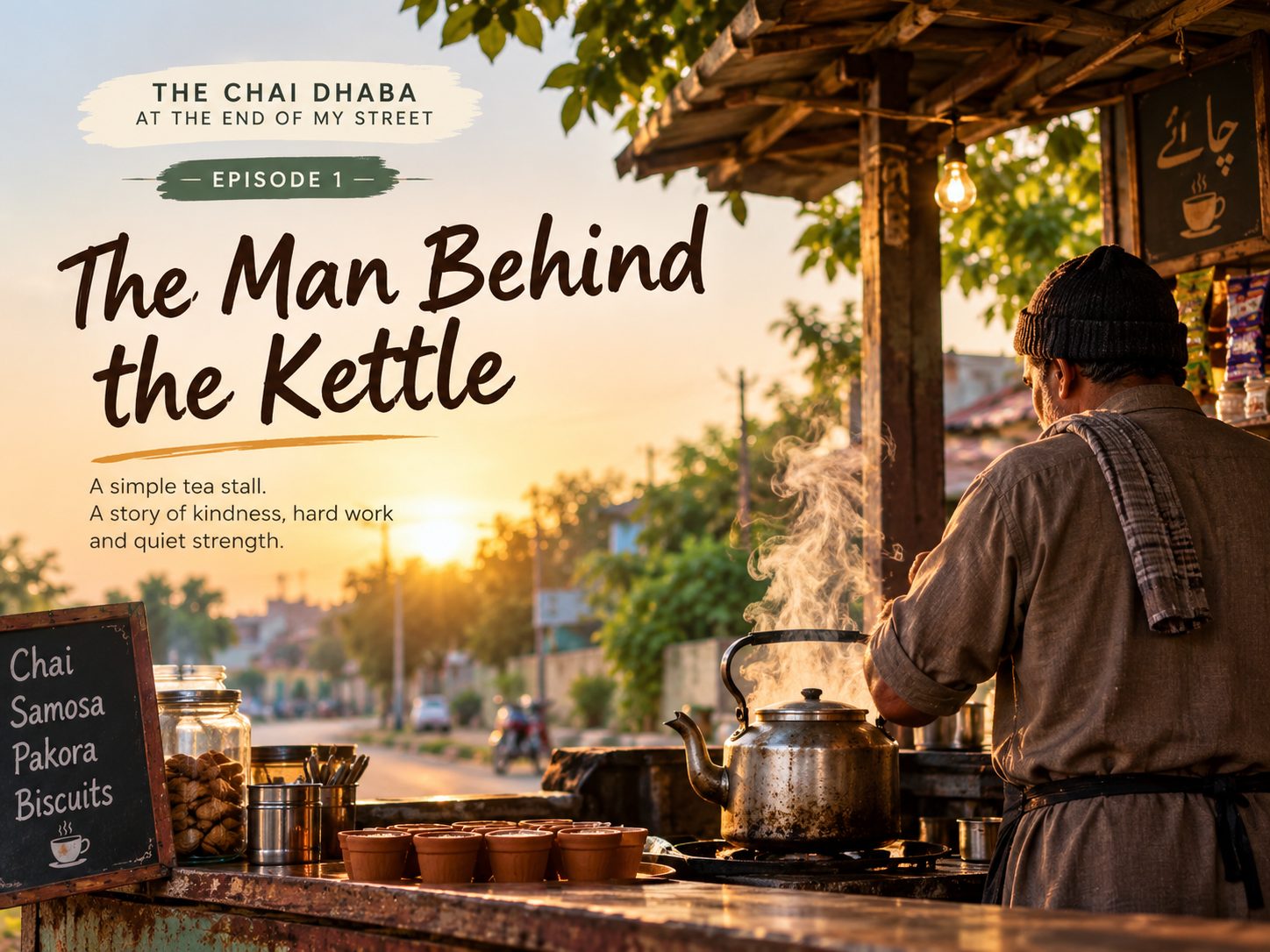
It has a tin roof, a gas stove and a huge, blackened kettle that never seems to cool down. There are two long wooden benches and a few plastic stools of different colours. A small glass cabinet holds rusks, biscuits and a few eggs. And there’s a radio, always playing old songs a little too loudly.
That’s it. That’s the whole business.
And yet, from five in the morning until nearly midnight, there’s almost always someone sitting there.
The man who runs it is in his late fifties. He’s thin and quick, with a grey beard, a white cap and forearms covered in tiny old burn marks. He moves around his stove like a dancer who has practised the same steps every day for thirty years. In a way, he has.
The first time I sat down and told him I wanted to write about his dhaba, he laughed.
“About me?” he said, pouring tea into a glass from high above, so it frothed at the top. “What is there to write? I make tea. People drink it. They go.”
Then he paused, looked at me properly, and added more quietly:
“But if you want to listen, I will talk.”
The Boy Who Came With Nothing
He was born in a small village in southern Punjab, the youngest of seven children. His father worked other people’s land. There was never enough money and never enough food.
“When I was seventeen, there was a bad year,” he told me. “The crops failed. My father was sick. Someone had to earn money. I was the youngest, but I was the one with no wife, no children. So I came to Lahore.”
He arrived at the bus station with one bag of clothes and very little money in his pocket. He knew nobody.
“The first night, I slept at the bus station,” he said. “I was so frightened. Such a big city, so much noise. I cried, but quietly, so nobody would see.”
For the next few years, he worked wherever he could. He washed dishes in a roadside restaurant, carried bricks on construction sites and sold peanuts from a cart in winter. Then he got a job as a helper at a tea stall near the railway station.
“That’s where I learned everything,” he said. “The old man who owned it was very strict. If the tea was not right, he would throw it on the ground and say, ‘Again.’ Again, again, again. I hated him.” He smiled. “Now, I thank him every day in my prayers.”
Seven years later, he had saved just enough to buy his own kettle and gas stove and to have two wooden benches made. He set up on an empty corner beside a new housing society on the edge of the city. There was mostly farmland around it then.
“People said I was mad,” he laughed. “‘Who will drink tea here? There is nobody!’ But I knew. Houses would come. People would come. And wherever there are people, they need tea.”
He was right. The houses came. The people came. And they’ve been sitting on his benches for almost thirty years.
The Secret of the Tea
Of course, I had to ask: what makes his tea so good?
Every person in our neighbourhood will tell you it’s the best in the area. Office workers drive past three modern cafés to get here. Students walk all the way from the main road.
He pretended not to hear me at first. Then he grinned.
“Everybody asks. Nobody understands.”
Finally, he explained, in his own way.
His tea is doodh patti, the most loved tea in Pakistan. There’s no water. Tea leaves are boiled directly in fresh milk with sugar and crushed cardamom, slowly, until the colour turns a deep, warm brown.
“Most people rush,” he said. “They boil it two minutes, finished. No. You must let it rise.” He lifted the kettle slightly as the milk foamed up. “Then let it fall. Then rise again. Three times, four times. The tea must wake up.”
The cardamom must be crushed fresh every morning, never from a packet. And the most important rule?
“Never, ever tea bags,” he said, with real disgust. “Tea bags are for people who don’t love tea.”
Then he said something else, more softly.
“But the real secret is not the milk or the cardamom. The real secret is you must make every cup like it is for your own father. If you make it only for money, people can taste it.”
I’ve thought about that line many times since. Make every cup like it is for your own father.
How different would the world be if we all worked like that?
The Notebook of Debts
On my third visit, I noticed a small, worn notebook tucked behind the sugar jar. Its cover was soft from years of handling.
“What’s that?” I asked.
He hesitated. Then he handed it to me.
It was a record of udhaar, money owed. Page after page of small amounts, written in careful Urdu next to short descriptions. Not names. He uses descriptions instead: “Tall man, blue motorbike.” “Student with glasses.” “Painter, works on new houses.”
“Some people don’t have money that day,” he said, shrugging. “So I write. When they have it, they pay.”
“And if they don’t?”
He took the notebook back and gently turned some pages. Some entries had a thin line drawn through them. A few pages had been carefully torn out.
“This one,” he said, pointing at a crossed-out line, “was a labourer. He drank tea here every morning for two years. Then he had an accident on a building site. He couldn’t work anymore. He went back to his village.” He shrugged again. “How can I ask him for money?”
He pointed to a torn edge where a page had been.
“And this page was an old man who sat here every evening. He passed away last winter. His son came to pay what he owed.” He shook his head slowly. “I said no. I tore the page out in front of him and said, ‘Your father paid me already. With his company.’”
He looked away and busied himself with the kettle for a while. I didn’t say anything. I didn’t trust my voice.
Who Asks About Him?
Here’s what struck me most, after many evenings on those benches.
People tell him everything. Students tell him about failed exams. Labourers tell him about their sick children back home. Office workers complain about their bosses. Old men tell him about the old days, again and again. He listens to all of it, nods and pours another cup.
So one evening, when the dhaba was quiet, I asked him something simple.
“How are you?”
He looked up, surprised. He actually stopped stirring.
“Me?”
“Yes. How are you? Really.”
He was silent for a long moment. Then he sat down on his own bench, which I had never seen him do.
“You know,” he said slowly, “in thirty years, I think maybe ten people have asked me that question.”
He told me about his wife, who still lives in a rented home nearby and sends him lunch every day in a steel tiffin box. He told me about his knees, which hurt badly from standing seventeen hours a day. He told me about his son, who is studying engineering at university, the first person in his family ever to go to university.
“I don’t want him to stand at a stove like me,” he said, his eyes shining. “I want him to sit in an office with a fan above his head. I want people to call him sir.”
Then he told me about his daughter, who is fifteen and wants to become a doctor.
“She says, ‘Abba, when I am a doctor, I will fix your knees for free.’” He laughed and wiped his eyes with the corner of his sleeve. “Free! As if I would ever let my daughter’s work be free.”
I asked if he was happy.
He thought about it very carefully.
“I am tired,” he said honestly. “My body is tired. But happy?” He looked out at his benches, his kettle and the people walking past on the road. “When I came to Lahore, I slept at the bus station with no one. Now, every day, hundreds of people come to me. They know my face. They trust my tea. Some of them, I have watched grow from boys into fathers.”
He smiled.
“I came to this city with nothing. This dhaba gave me a family. So yes. I think I am happy.”
The Last Cup of the Night
On my final night of interviews, I stayed until he closed.
It was almost midnight. The road was quiet. The last customer, a tired delivery rider, finished his tea and rode away into the dark. The radio played one final old song.
He washed every glass cup one by one, dried them carefully and lined them up on a shelf for the morning. He wiped down the benches. He turned off the gas.
Then he did something I didn’t expect.
He made one more cup of tea. Just one. And he handed it to me.
“For you,” he said. “No charge.”
I tried to pay. He refused firmly.
“You asked how I am,” he said. “Nobody asks. That is worth a cup of tea.”
I sat on his bench in the dark, holding that warm glass in both hands, and I cried a little. Quietly, so nobody would see.
Just like he did, thirty years ago, at the bus station.
In Episode 2, we’ll meet the people who sit on his benches, from the labourers at dawn to the delivery riders at midnight, and the stories they bring with them.
All episodes
- 1 The Man Behind the Kettle (reading now)
- 2 One Cup, Many Lives 🔒
- 3 Will the Dhaba Survive? 🔒