Traditional Schooling in a Changing World: Are We Preparing Our Children for Life or Just for Exams?
An honest look at education, parenting, and the future our children are growing into.

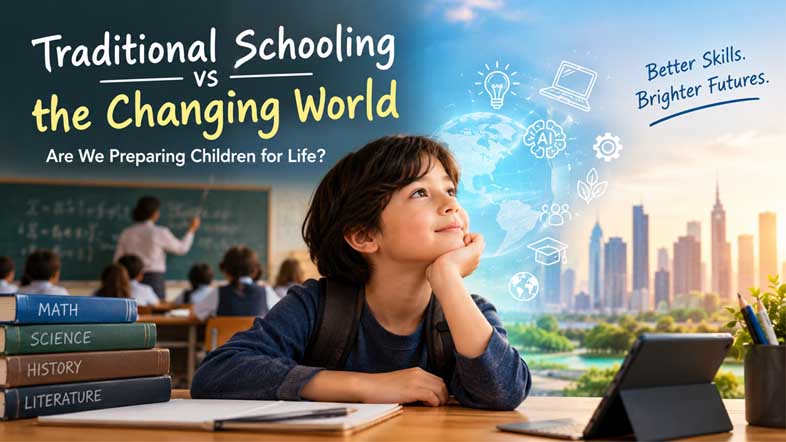
Imagine a classroom twenty years ago.
Children are sitting quietly at their desks. The teacher is standing in front of the blackboard, explaining a lesson. Students are copying notes, memorising answers, and preparing for the next examination. The child who gets the highest marks is praised. The child who struggles with mathematics or forgets a history date is told to work harder.
For generations, this was considered the right way to learn.
Now imagine a classroom today. Some children are using tablets, artificial intelligence can explain complicated topics in seconds, and students can learn from teachers on the other side of the world without leaving their bedrooms. A child can create a website, learn a new language, or explore the solar system with a few clicks.
The world has changed dramatically.
But here is the uncomfortable question: Has our approach to education changed as much as the world our children are entering?
We still ask children to sit examinations, memorise information, compete for grades, and follow a system that often treats success as a number on a report card.
Meanwhile, the real world increasingly asks them to think independently, communicate confidently, solve unfamiliar problems, work with others, adapt to change, and learn things that may not even exist today.
Something does not quite add up.
And as parents, teachers, and members of society, perhaps it is time we had an honest conversation about it.
1. The School System That Worked for Our Generation
Before criticising traditional schooling, we should understand why it developed in the first place.
For many generations, education followed a fairly straightforward path. Children attended school, learned reading, writing, mathematics, science, and other subjects, passed examinations, went to university, and eventually found employment.
For much of the twentieth century, this model served an important purpose. Many jobs required people to follow established procedures, remember information, work within clear structures, and perform consistent tasks.
A good education could open doors to a stable career and a better life.
Our parents and grandparents often grew up believing that education was the most reliable route to financial security. Their advice was familiar:
"Study hard, get good marks, find a good job, and your future will be secure."
And honestly, that advice was not wrong. Education has transformed millions of lives, including those of people who came from humble backgrounds.
The problem is not that traditional education has no value. The problem is that a system designed for a different world cannot automatically prepare children for every challenge of today's world.
Think about the difference between the working lives of our parents and those of our children.
A person might once have spent thirty years working in one profession, gradually moving up the career ladder. Today, someone might change industries, learn new digital skills, work remotely with an international team, or build a business online.
Some jobs are disappearing. New ones are emerging. Entire industries are being reshaped by automation and artificial intelligence.
Yet many children are still being judged primarily on how well they remember information and reproduce it under examination conditions.
We need to ask ourselves whether that is enough.
2. When Good Grades Become More Important Than Learning
Consider a familiar scene in many homes.
A child comes back from school carrying a report card. The parents immediately look at the marks.
"How much did you get in mathematics?"
"What did your friend score?"
"Why did you lose five marks in science?"
If the child scores 95%, everyone is happy. There may be a celebration, a special dinner, or a promise of a new phone.
If the child scores 72%, the mood changes.
The child may have worked hard, understood most of the lessons, helped a classmate, and shown real improvement. But those achievements can suddenly feel insignificant because the final number is lower than expected.
Over time, the child learns something important, although nobody may have intended to teach it.
My worth depends on my marks. My success depends on being better than someone else. Making mistakes means disappointing the people I love.
This is where education can quietly become a source of anxiety rather than curiosity.
Imagine a student who loves drawing, enjoys taking things apart to understand how they work, and constantly asks questions about the world. However, the student struggles with timed examinations.
Another student has an excellent memory, performs well in tests, and follows instructions perfectly.
In a conventional examination-based system, the second student may consistently receive more recognition.
But what happens ten years later?
The first student might become an innovative architect, product designer, entrepreneur, or engineer. The second might also become highly successful, of course. There is no reason to assume otherwise.
The point is that examinations reveal certain abilities, but they cannot capture the full range of a person's potential.
A mark can tell us something about how a student performed in a particular assessment. It cannot tell us everything about their creativity, resilience, emotional intelligence, leadership, curiosity, or ability to solve a real-world problem.
Nor should we dismiss academic achievement. Strong literacy, numeracy, scientific understanding, and disciplined study remain essential.
The real issue begins when grades become the entire definition of intelligence.
Children do not all learn in the same way, at the same speed, or through the same interests. Some understand a concept by reading. Others need to see it, build it, discuss it, or experience it.
When we recognise only one kind of achievement, we risk overlooking the very abilities that could help a child flourish.
3. The World Outside the Classroom Is Playing by Different Rules
Imagine two young adults applying for their first jobs.
Both have university degrees. Both have respectable academic records.
During the interview, one candidate can explain theories and definitions perfectly but struggles when asked to solve an unfamiliar problem.
The other candidate has similar academic knowledge but can also communicate ideas clearly, work through uncertainty, accept feedback, and explain how they would approach a practical challenge.
Which candidate would an employer prefer?
The answer depends on the role, but many employers increasingly value a combination of technical knowledge, communication, problem-solving, adaptability, and the ability to work with others.
This is not a rejection of education. It is a recognition that education must prepare people to use what they know.
Think about everyday life.
A young person may earn excellent marks in mathematics but have little understanding of budgeting, borrowing, interest, or saving.
A student may study English for years but feel terrified when asked to speak in front of a group.
A teenager may know the scientific definition of stress but have no idea how to manage disappointment, conflict, or failure.
A graduate may understand business concepts but struggle to organise a project, communicate with a team, or make a decision when the answer is unclear.
These are not signs that the students have failed. They are signs that the learning experience may have left some important gaps.
Life rarely provides four possible answers with only one correct choice highlighted in the marking scheme.
Sometimes there is incomplete information. Sometimes every option has consequences. Sometimes you make a reasonable decision and still get an unexpected result.
Real life demands judgement, responsibility, patience, and the courage to try again.
Our children deserve opportunities to practise these things before they are expected to handle them as adults.
4. Artificial Intelligence Has Changed the Meaning of Knowing Something
A few decades ago, finding information could take considerable effort.
You might have needed to visit a library, search through encyclopaedias, consult a specialist, or spend hours reading different books.
Today, a student can ask an AI tool to explain a difficult physics concept, generate practice questions, translate a passage, or suggest ideas for a school project.
Information is more accessible than ever.
That creates an enormous opportunity, but it also presents a challenge for education.
If a student can find an answer in seconds, what exactly should the student learn?
The answer is not to stop teaching facts. We still need foundational knowledge to understand the world, recognise misinformation, and make informed decisions.
But we also need to teach children how to question information, evaluate evidence, identify mistakes, and use technology responsibly.
Imagine a student writing an assignment about climate change. An AI tool can produce a polished essay in moments. The student could simply submit it and move on.
But consider a different approach.
The teacher asks the student to compare the AI-generated explanation with reliable scientific sources, identify unsupported claims, discuss the evidence, and explain the conclusion in their own words.
Now the student is learning something much more valuable than how to produce an essay.
The student is learning how to think.
This distinction will become increasingly important as technology advances.
When information is easy to obtain, the ability to judge its quality becomes more valuable. When machines can perform certain tasks, human strengths such as ethical judgement, empathy, creativity, collaboration, and contextual understanding remain essential.
Of course, AI can assist with many tasks associated with these areas, too. We should not pretend that any skill is completely protected from technological change.
Instead, children need to learn how to work effectively with technology while understanding its limitations.
They need to know when to use a tool, when to question its answer, when to verify information, and when a decision requires human responsibility.
The future will not belong only to those who know the most facts. Nor will it automatically belong to those who use the newest technology.
It will favour people who can combine knowledge, judgement, adaptability, and the ability to keep learning.
5. The Child Who Is Afraid to Make a Mistake
There is another side to this discussion that deserves our attention: the emotional experience of being a student.
Imagine a child sitting in a classroom who knows the answer to a question.
The child wants to raise a hand but hesitates.
"What if I am wrong?"
"What if everyone laughs?"
"What if the teacher thinks I am not clever?"
So the child stays silent.
This may seem like a small moment. But imagine it happening repeatedly over several years.
The child begins to associate participation with risk and silence with safety. Eventually, even when the child has an idea, they may find it difficult to express it confidently.
Now imagine a classroom where the teacher responds differently.
A student gives an incorrect answer. Instead of embarrassment or criticism, the teacher says, "That's an interesting attempt. Tell me how you reached that conclusion."
The class explores the reasoning together. The student discovers where the mistake occurred and tries again.
In that classroom, mistakes are not celebrated for their own sake. They are treated as part of learning.
This is how confidence develops.
Not because a child is told they are brilliant every day, but because they experience the process of trying, struggling, improving, and eventually understanding.
The same principle applies to life outside school.
Children who never get the chance to make manageable mistakes may struggle when they eventually face larger disappointments. If every difficulty is removed by an adult, they have fewer opportunities to practise making decisions and dealing with consequences.
We cannot protect children from every failure, and we should not want to.
We should protect their dignity, support them when things go wrong, and help them learn from the experience.
A child who gets a question wrong is not a failure.
A child who needs more time to understand a concept is not less intelligent.
And a child who struggles today should never be made to feel that their future has already been decided.
6. Parents: Are We Preparing Children for Life or for Our Own Expectations?
This is perhaps the most uncomfortable part of the conversation because it asks us to look at ourselves.
Most parents want the best for their children. They want them to have opportunities, financial stability, respect, and a life that is easier than the one they may have experienced.
These are natural wishes.
Many parents also carry memories of their own struggles. Perhaps they missed educational opportunities. Perhaps their families could not afford certain things. Perhaps they worked hard for years to establish financial security.
As a result, they may see high grades, prestigious universities, and well-paid professions as the safest path forward.
Their intentions are usually rooted in love.
But sometimes love becomes pressure without us realising it.
Consider a teenager who wants to study graphic design, filmmaking, game development, or another creative subject.
Their parents might respond immediately:
"How will you earn money?"
"Why don't you choose medicine, engineering, or business?"
"What will people say if you choose something different?"
These questions may come from genuine concern. Financial security matters, and young people need realistic advice about employment, training, and career opportunities.
But there is a difference between helping a child evaluate a choice and dismissing that choice before understanding it.
Perhaps the teenager has a strong portfolio, enjoys solving design problems, understands digital tools, and is willing to work hard to develop professional skills.
Perhaps they need guidance on the best courses, industry opportunities, and financial realities rather than a blanket rejection of their ambitions.
On the other hand, perhaps the teenager has not explored the field enough to understand its challenges. In that case, the parent can help them research careers, speak with professionals, and test their interest through small projects.
Both approaches are forms of responsible parenting.
The aim is not to agree with every dream a child expresses. It is to help the child make informed decisions without teaching them that their interests have no value unless they fit someone else's expectations.
We should remember something important: our children are growing up in a world we did not experience, and they will face decisions we cannot fully predict.
Our experience is valuable, but it is not a complete map of their future.
Sometimes the most helpful question is not, "Why can't you choose the path I understand?"
It is, "Let's explore this path together and understand what it would take to succeed."
7. The Hidden Lessons Children Need but Rarely Find in Textbooks
Imagine a school timetable that includes mathematics, science, languages, history, and physical education.
Now imagine adding practical lessons in personal finance, emotional awareness, communication, critical thinking, digital responsibility, and everyday problem-solving.
Students learn how to create a realistic budget, understand interest on loans, recognise online scams, resolve disagreements, manage time, and make thoughtful decisions.
They practise speaking to an audience, collaborating on a project, receiving feedback, and explaining why they changed their minds after examining new evidence.
Would these lessons replace academic subjects?
They should not.
A child needs both a strong academic foundation and opportunities to apply that knowledge.
Consider personal finance. A student might learn percentages in mathematics and later apply them to interest rates, discounts, savings, and the cost of borrowing.
Consider communication. A student might study literature and then practise presenting an interpretation, listening to opposing views, and supporting an argument with evidence.
Consider science. Instead of only memorising scientific principles, students could design an experiment, record results, examine unexpected outcomes, and explain what they learned.
The academic subject becomes more meaningful when children can see how it connects to life.
These experiences also teach something that is difficult to measure in a conventional examination: responsibility.
A student who works on a group project discovers that missing a deadline affects other people. A student who organises a school event learns to plan, delegate, and adapt when something goes wrong. A student who manages a small project budget begins to understand the relationship between choices and consequences.
These lessons are not always neat. They involve frustration, negotiation, and occasional mistakes.
That is precisely why they matter.
Real life is not a multiple-choice paper. It is an ongoing process of making decisions, learning from results, and adjusting our approach.
Education should give children a safe place to begin practising that process.
8. What Should a Modern School Look Like?
A modern school does not need to abandon everything traditional.
Children still need teachers who explain difficult ideas, books that encourage deep reading, structured lessons, academic discipline, and examinations that help assess progress.
The teacher's role, however, can extend beyond delivering information.
A teacher can become a guide who helps students ask better questions, connect ideas, explore possibilities, and understand how to apply knowledge.
Imagine a lesson about environmental sustainability.
Students could learn the scientific principles, study relevant data, calculate waste or energy consumption, interview people in their community, and develop a practical proposal to reduce waste at school.
They would still learn science, mathematics, writing, and research. But they would also practise collaboration, creativity, communication, and critical thinking.
Or consider a lesson about entrepreneurship.
Students could work in teams to develop a simple product or service, identify the needs of potential customers, estimate costs, calculate prices, and present their ideas.
Some ideas would work. Others would not.
Students would discover that a good idea is only the beginning. They would need planning, feedback, persistence, and the ability to respond to problems.
These activities do not require every school to have expensive technology or elaborate facilities. A great deal can be achieved through thoughtful teaching, practical projects, discussion, and community involvement.
Technology can help, but it should support meaningful learning rather than become a substitute for it.
Schools can also make assessment more balanced by combining examinations with projects, presentations, practical work, and opportunities to demonstrate improvement.
No single assessment method captures every ability. A mixture provides a broader picture of what students understand and can do.
Of course, change takes time. Teachers need training, school leaders need support, curricula must be carefully designed, and students need clear standards.
A modern education system should not simply add more activities to an already crowded timetable. It should make thoughtful decisions about what matters most.
The objective is not to make learning easier.
It is to make learning more relevant.
9. Teachers Are Not the Problem. They Need Our Support.
Whenever people discuss education reform, teachers sometimes become the easiest target.
We say schools are outdated, teachers rely too heavily on memorisation, and classrooms do not prepare children for life.
But we should also consider the conditions under which teachers work.
Many teachers manage large classes, demanding curricula, administrative responsibilities, examination requirements, and parents who expect outstanding results.
They may genuinely want to encourage creativity and independent thinking while still being expected to cover a long list of topics before a fixed examination date.
Imagine a teacher who wants students to explore a subject through a practical project but has limited time, resources, and flexibility in the curriculum.
It is not enough to tell that teacher to innovate.
The system must make innovation possible.
Teachers need professional development, useful technology, manageable workloads, supportive leadership, and the freedom to use methods that improve learning while meeting academic requirements.
They also need parents to understand that learning is not always a smooth, measurable process.
Sometimes a student needs additional time. Sometimes a lesson produces more questions than answers. Sometimes the most important learning happens when an experiment fails or a discussion challenges an assumption.
These experiences may not immediately produce a higher mark, but they can deepen understanding.
Teachers are not merely preparing children for examinations. At their best, they help shape how children think, communicate, relate to others, and understand themselves.
That responsibility deserves greater recognition and support.
10. The Digital World: More Opportunities, More Responsibility
Children today can access educational videos, online courses, international communities, creative tools, and learning resources that previous generations could hardly imagine.
A teenager interested in coding can begin building simple applications at home. Someone passionate about photography can learn composition and editing online. A student curious about astronomy can explore university lectures and digital simulations.
These opportunities can be life-changing.
A child does not have to wait for a formal qualification to begin exploring an interest. They can experiment, create a portfolio, join a community, and gradually discover what they enjoy.
But the same digital world brings serious challenges.
Social media can encourage constant comparison. Online entertainment can compete with sleep and concentration. Misinformation can spread quickly. Cyberbullying can follow a child beyond school hours and into the privacy of their home.
And because technology is designed to capture attention, children may struggle to balance immediate entertainment with activities that require patience.
The answer is neither to give children unlimited access nor to assume that all technology is harmful.
They need guidance.
Parents and schools can help children develop healthy digital habits, protect personal information, recognise manipulative content, and understand that online popularity is not a reliable measure of personal worth.
They can also encourage children to use technology actively rather than passively.
Instead of spending every available hour consuming content, a teenager might learn to create a video, build a simple website, research a topic, develop a digital artwork, or solve a problem using an appropriate tool.
The important question is not simply how much time a child spends online.
It is also what the child is doing, how it affects their wellbeing, and whether they are developing the judgement to make responsible choices.
Digital literacy should be more than knowing how to use an application. It should include knowing when to disconnect, how to evaluate information, and how to behave responsibly in a connected world.
11. Success Will Not Look the Same for Every Child
Perhaps the most important change we need to make is in how we define success.
For too long, many families have treated education as a race with a familiar finish line: excellent grades, a prestigious university, a respected profession, and a comfortable income.
There is nothing wrong with aspiring to any of these things.
The difficulty begins when we assume that every child must follow the same route to achieve a meaningful life.
Think about a student who performs exceptionally well in examinations and wants to become a doctor. That student deserves encouragement, excellent teaching, and the opportunity to pursue that ambition.
Now think about a student who is a gifted musician, a thoughtful problem-solver, or a natural entrepreneur. Perhaps that student does not perform equally well across every academic subject.
Does that make their potential less valuable?
Of course not.
It simply means that their strengths, interests, and development may follow a different pattern.
Recognising individual strengths does not mean lowering expectations or pretending that qualifications do not matter. Different careers require different levels of training, knowledge, discipline, and professional competence.
A future doctor must meet rigorous academic and clinical standards. An engineer must understand the principles behind their work. A financial professional needs strong analytical skills.
But within those requirements, children need room to discover where their abilities and interests meet real opportunities.
Some will thrive in academic research. Others will excel in skilled trades, technology, design, healthcare, business, education, or creative industries.
The world needs different kinds of talent.
A healthy education system should help children understand their strengths, recognise areas for improvement, and explore realistic paths towards meaningful work.
It should not make a child feel that one disappointing examination result has permanently closed the door to a successful future.
Life is rarely that simple.
People grow, change direction, discover new interests, and develop abilities that were not obvious when they were teenagers.
Our children deserve the space to grow into themselves.
12. What Can Parents Start Doing Today?
We do not have to wait for governments, education departments, or school leaders to redesign the entire system before making a difference.
Small changes at home can influence how children understand learning and success.
Start by changing the questions you ask.
Instead of asking only, "What marks did you get today?", try asking, "What was the most interesting thing you learned today?"
Ask what challenged them, what surprised them, or what they would like to understand better.
These questions send a powerful message: learning matters even when there is no examination.
Praise effort, curiosity, and improvement.
This does not mean praising every attempt regardless of quality. It means recognising persistence, thoughtful decisions, honest effort, and the willingness to improve.
If your child struggles with a subject but keeps practising and gradually improves, acknowledge that progress.
Allow age-appropriate independence.
Let children plan a small family activity, manage a reasonable allowance, organise their study schedule, or take responsibility for a suitable household task.
Offer guidance, but resist the temptation to control every detail.
Independence develops through practice.
Make room for interests beyond school.
A child who loves football can learn teamwork and discipline. A child who enjoys cooking can explore measurement, planning, and nutrition. A child who enjoys building things can develop practical reasoning and creativity.
Not every interest needs to become a career. Sometimes an activity is valuable simply because it brings joy, confidence, and a sense of discovery.
Talk honestly about failure.
Share age-appropriate examples of times when you made a mistake, faced disappointment, or had to learn something unfamiliar.
Explain what happened, what you learned, and what you did differently afterwards.
Children often assume adults have everything figured out. Showing them that growth continues throughout life can make their own struggles feel less frightening.
And finally, remind your children that your love is not a reward for academic performance.
They should know that you will celebrate their achievements, help them improve where they struggle, and support them through disappointments.
A child who feels secure at home is better placed to take healthy risks, ask questions, and learn from mistakes.
13. The Future Belongs to Lifelong Learners
Let us imagine a teenager graduating from school ten years from now.
The teenager has learned mathematics, science, languages, and the foundations of many other subjects. But that is not all.
They know how to research a question, check information, communicate an idea, and work with people who think differently.
They understand basic financial responsibility. They have experienced completing projects, handling feedback, and adjusting when something does not work.
They understand that artificial intelligence can be useful but that its answers must be evaluated. They know how to learn independently and where to seek help when they are out of their depth.
Most importantly, they do not believe that learning ends when school or university finishes.
They understand that their first job may not be their last, that new tools will emerge, and that they may need to develop new skills throughout their lives.
This is a much more realistic picture of readiness for the future.
No school can predict every challenge a child will face. No parent can guarantee that a particular qualification will lead to lifelong security. And no education system can teach every skill a person will ever need.
But schools and families can help children develop the foundations that make change easier to navigate.
Curiosity helps them explore.
Critical thinking helps them evaluate.
Discipline helps them persist.
Communication helps them connect.
Emotional awareness helps them understand themselves and others.
And a willingness to keep learning helps them adapt.
These qualities do not replace subject knowledge. They help people make better use of it.
Conclusion: Let Us Educate Children for the World They Will Live In
Traditional schooling has given generations of children valuable knowledge, discipline, qualifications, and opportunities. We should respect those contributions rather than dismiss them.
But respect for the past should not prevent us from improving the future.
The world our children are growing into is different from the one many of us knew at their age. Technology is changing how people work, information is becoming easier to access, and the demands of daily life continue to evolve.
Our education systems must respond thoughtfully to these changes.
That does not mean abandoning examinations, academic standards, or established subjects. It means recognising that these are part of education, not the whole purpose of it.
A good education should help a child read a book, solve a mathematical problem, understand a scientific principle, and write clearly.
It should also help that child ask difficult questions, work through uncertainty, treat others with respect, manage disappointment, and make responsible decisions.
And parents have an important role to play.
We need to celebrate achievement without making grades the measure of a child's worth. We need to encourage ambition without imposing a single definition of success. We need to protect children while allowing them to develop independence.
Above all, we need to remember that education is not simply about preparing children to pass the next examination.
It is about preparing them to live meaningful, responsible, and adaptable lives.
One day, our children will leave the classroom. They will face decisions for which there is no textbook answer. They will encounter problems their teachers never discussed and opportunities we could not have imagined.
When that day comes, we should hope they carry more than certificates and report cards.
We should hope they carry the confidence to try, the humility to learn, the courage to ask for help, and the resilience to begin again.
Because the real measure of education is not only what a child remembers when an examination ends.
It is what that child can do, how they think, how they treat other people, and how they continue to grow when life presents something new.
Perhaps it is time we stopped asking only, "How well are our children performing in school?"
And started asking a much bigger question: "How well are we preparing them for life?"
That is a question worth asking—not just for our children, but for the future we are building together.